Showing posts with label Cook the Books Club. Show all posts

Wednesday, May 29, 2013

Eggs The Color of Tea

Way back when, the Crispy Cook was a young sprig who served as an Au Pair for a family one summer. On my time off I would ride a bike into the little touristy beach town nearby and prowl around, but for a teen in a strange town with no money, there wasn't much to do besides poke around the local antique and souvenir shops. After a couple of these sojourns, I just ended up spending my down time relaxing and reading in my room.

The house was well-stocked with books, and being a foodie in training, I often picked a cookbook out of the shelves to peruse. I remember writing down many recipes out of the 1000 Recipe Chinese Cookbook by Gloria Bey Miller and being fascinated by the variety of intriguing ingredients and types of cuisine that were presented in its pages. One of the recipes I remember vividly was for Tea Eggs, hard-cooked eggs steeped in black tea and fragrant spices.

I never did get around to making these eggy delicacies until just last week, after having read the latest selection for Cook the Books, the online book club that I and three of my blogger buddies take turns co-hosting every other month. Our featured book this time 'round is The Color of Tea, by Hannah Tunnicliffe, and the author herself has graciously agreed to serve as the judge of our contributed posts about the book and the dishes we were inspired to make.

The Color of Tea is an interesting novel about an English woman married to an Australian man, who emigrate to the south China island of Macau after husband Pete lands a job supervising construction of a new gambling casino. Macau is a former Portuguese colony and the culture is an amalgam of Eastern and Western influences, as our heroine Grace discovers in her new life.

Grace and Pete are recovering from multiple rounds of unsuccessful infertility treatments, and as one way of clawing her way out of her malaise, Grace decides to open up a tea shop that specializes in delicately colored and flavored pastries, including many varieties of macarons, those delicate French almond and meringue confections. That's when I really got into the novel, with its descriptions of the customers and coworkers that Grace befriends. The reader finds out the intriguing back stories of these people and of Grace herself, which makes her a lot of more sympathetic than she was to me at the beginning of the tale. I also enjoyed learning more about the issues that foreign workers face which is an integral thread in the novel as well.


One thing that really irked me, though, was the front cover art. It's a delicious looking cover, alright, but given that our protagonist was a redhead, I kept waiting for some explanation of who the long-lashed brunette was featured on the cover. Shouldn't the art department have some conversations with the editorial department at the old publishing house before the book is cranked out?

Back to the Tea Eggs....Reading this book provided the perfect opportunity to finally eggs-periment with making Tea Eggs, as I imagined that might be something found on the menu at Lillian's, Grace's Macau cafe. I found a recipe over at Tiny Urban Kitchen, and it was simple enough: hard boil some eggs, then tap the shells to crack them all over and then simmer (for two hours!) in a mixture of black tea and star anise. I didn't have star anise, but did have some five-spice powder, so I made a small batch. They were beautiful colored with a crazed pattern of brown and white, but to me they weren't much different in taste from a plain old hardcooked egg. They were rubberier in fact, from all those extra minutes in the pot and had that greenish ring around the yolks that one gets from overcooking eggs. Ah well, at least I finally satisfied my curiosity about this dish and I remembered how delicious five-spice powder is, so I will utilizing that more in the kitchen.

Please join me in visiting the other Cook the Books posts about The Color of Tea back at the blog. Deb of Kahakai Kitchen is our wonderful hostess this round and she will be shortly posting the roundup of writings and recipes about our featured novel.

And feel free to join the regulars in our foodie book club in reading our June/July book pick, M.F.K. Fisher's collection of essays, "How to Cook a Wolf". 


Sunday, September 9, 2012

A Picnic Farewell to the Saratoga Racing Season

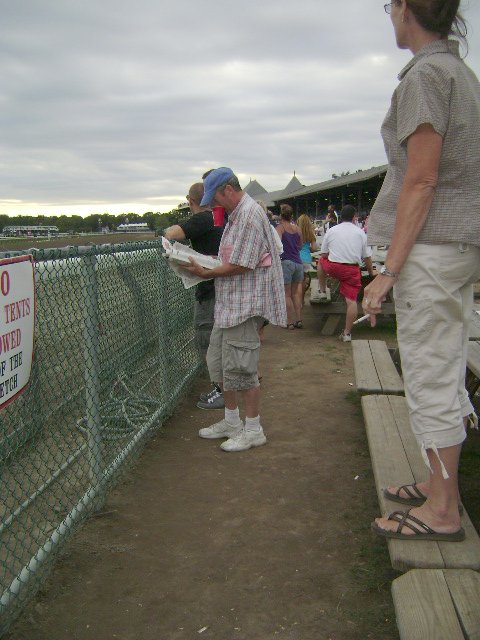
It was an impromptu gathering of friends to celebrate the end of summer and a chance to hang outside watching beautiful thoroughbred race horses thunder past us. Our venue was the historic Saratoga Springs Race Track. on Labor Day, the last day of the summer racing season. The racetrack offered free admission for that day, which was a nice bonus. Dan and I went early in the morning to claim a picnic table at The Top of the Stretch (where the horses make their last straightaway sprint to the finish line) by draping our tablecloth on a table near the fence. Next time I will leave the vase of zinnias home, which, though it was kind of a classy addition, invited pesky yellow jackets and wasps to our table.

Husband Dan used to go more often in his youth and we were astonished at how many years had passed since we had attended the races. Neither one of us is much of a gambler, but it is always a fun time because the people watching is superb. You'll see fashions aplenty from nattily dressed and hatted ladies strolling through the clubhouse to cigar-chomping OTB regulars perusing the racing papers with great intensity.

We arrived early and brought our picnic fare and feasted like kings. The weather cooperated with sunshine and not too much humidity, though when the track guys came around in their track misters, we did enjoy the spray of water on our faces turning like sunflowers in the light.

Our friends brought a splendid array of delicious foods. We ate some luscious lemony deviled eggs (I'll have my friend Ellen's recipe posted up soon), rice and pasta salads, gazpacho, cheeses, fruit, and other edibles, all packed up in various non-glass containers as per track rules). Then there was this luscious cold zucchini salad, inspired by one of Laurie Colwin's essays from her book "Home Cooking".

You start with a platter of fried zucchini.

I used three largish zucchini, which kept me stationed over a large cast-iron frying pan for a good while the day before. I breaded my zucchini with a mixture of brown rice flour and chickpea flour. They were moist enough after slicing to not require any eggy painting to make the flour adhere. After I drained and cooled these fried zucchini slices, I layered them with dabs of an 8 oz. log of goat cheese, chopped parsley and basil, and sliced bits of a 12 oz. jar of roasted red peppers. Salt and pepper went between the layers, they got a splash of olive oil and vinegar and that was a wonderful salad that was delicious at room temperature the next day and kept well under the hot temperatures during our al fresco track picnic.


Now, to focus more attention on Colwin's delightful book, Home Cooking, which is the featured selection for Cook the Books, the online foodie book club started by me, my buddy Deb of Kahakai Kitchen and my buddy Jo of Food Junkie, Not Junk Food. This book was published in 1988, and has been in my home library since shortly thereafter. Colwin was just a bewitching writer; she was witty, self-deprecating, passionate about the things she loved, and her descriptions of dinner parties (even the ones that went awry) are mouthwatering.

My favorite essay is entitled Kitchen Horrors, and I can read and reread this comic chapter and still chuckle out loud. There are so many disasters described in its pages, but none more hilarious than the strange English dessert Colwin attempted to make for an Easter dinner, called Suffolk Pond Pudding. It involved a sugar-encrusted lemon atop some butter and sugar, wrapped in a suet crust and then steamed in a kettle for FOUR HOURS. Well, that's enough description for me, and I certainly wouldn't want to have to ingest it, but Colwin sallied forth and when she produced her dessert, the comments on its appearances included suggestions that it looked like a baked hat and the Alien. The taste produced further editorial commentary: "This tastes like lemon-flavored bacon fat", "I'm sure it's wonderful, I mean, in England", and the straight-forward "This is awful". Ha!

Sadly, Colwin died at the tragically young age of 48 from a heart attack (her descriptions of her go-to comfort food, rosti, may have been a complicating factor), so there are not many other Colwin titles to read through, though there is a sequel to this book, More Home Cooking, to look forward to.

My zucchini salad was inspired by an essay in Home Cooking, entitled Red Peppers. In it, Colwin describes a favorite dish from an East Side restaurant that she didn't get to often enough. It involved layers of sauteed zucchini slices and pimento strips garnished with olive oil, fresh garlic and lemon juice, which sounds great too.

Deb is hosting this current round of Cook the Books, so be sure to check back at our book club website after the September 24th deadline to see Deb's roundup of all the Home Cooking posts.

Friday, January 20, 2012

In Which I Become an Outlaw Cook with John Thorne

Running a used bookstore for the last fifteen years has educated me about which books are treasured, or perhaps guarded is a better word, by their owners and hardly ever relinquished back into the market. I rarely get any books in the shop about blacksmithing, stained glass or rare coins; such classics as To Kill a Mockingbird, Catch-22, The Cat in the Hat and Gone with the Wind don't show up to be traded; and works by a select group of authors and illustrators like Shirley Jackson, W.H. Auden, Edward Gorey, Kurt Vonnegut, Tasha Tudor and Philip K. Dick are seldom brought to our doors.

Add food writer John Thorne's books to this elite list. I was first made aware of his work many years ago by my bibliophilic friend Myra, who asked me to keep an eye out for Thorne's books. After at least a decade, I had yet to find any such titles in my shop or out book hunting, until one day when I was on a holiday in Great Barrington, Massachusetts at Yellow House Books, and spied a copy of  Outlaw Cook (NY: Farrar, Straus, Giroux: 1992), a collection of food essays written with his wife Matt Lewis Thorne. I snapped it up and devoured it with great pleasure over the next several weeks and am waiting to savor another of his books, Mouth Wide Open, which is at the top of my bedside room reading pile.

Now I know why Thorne's books never show up in the shop. They are to be savored and reread, bookmarked and propped open on the kitchen counter, and reread again. I chose Outlaw Cook for the current round of Cook the Books, the online foodie book club started by me, and two lovely blogger friends: Deb of Kahakai Kitchen in Hawaii and Johanna of Food Junkie, Not Junk Food in Greece.  For this bimonthly blog event, participants are asked to read our chosen book, blog about it and cook something up that is inspired by our reading. Anyone can join the "regulars" in this book club by posting and then leaving a comment at the Cook the Books site. The deadline for this round is January 23, 2012, and I am delighted that our featured author, John Thorne, will be reviewing the submitted posts and picking a winner to receive the coveted CTB winner's badge.


Thorne's prose is an interesting mixture of the erudite and the commonplace. One will learn much about a lot of different subjects, and need to look up many things along the way, but the writing is simple and direct and full of great quotes and turns of phrase. There are many intriguing essays in the book which explore different dishes and cultural traditions, some autobiographical asides, reviews of cookbooks and examinations of food personalities. Outlaw Cook devotes many pages to bread baking and outdoor hearths and there's a gloriously evocative chapter on Russians' love affair with mushrooms.

I really like Thorne's approach to trying out a new recipe or ingredient. Once something strikes his fancy, he's on an adventure to study it and make it his own. He reads about it extensively, cooks up many variations and then presents the reader with his findings. Whether it's hunting for the perfect meatball, simple pasta dishes, black beans and rice, pea soup or the best thing to do with a bounty of summer raspberries, there's lots of research and development in the Thorne kitchen and library and plenty of references offered up for further exploration.


As an avid member of the Order of the Stinking Rose, I was particularly entranced by the essay on garlic soup. I've made creamy, decadently rich garlic soups and delicate garlic and rice soups, and thought that covered much of the culinary territory on that subject. Not so fast, says Thorne, with his musings on various Mediterranean permutations of garlicky broths. There's the paprika and saffron-laced Sopa de Ajo of Spain, France's Soupe a l'Ail Bonne Femme studded with potato and tomato, herb-redolent Aigo Bouido from Provence and even a cold Garlic and Walnut Soup with Fresh Goat Cheese.  Most of these soups require a crusty piece of toasted bread sunk at the bottom of the soup bowl, and since my gluten-free breadbaking production neither produces quantity nor quality (witness the hockey puck "fluffy bun"example in the photo below), I turned to my trusty recipe card file for a breadless garlic soup recipe instead.

 
My garlic soup recipe is of origin unknown, most likely copied out of a cookbook borrowed from the public library during my foodie youth, but I tinkered with it enough to confidently call it my own adaptation. It's a very herb-redolent broth, perfect for bolstering the winter-ravaged immune system  and imparting a warm glow after a day battling the wind and cold. Just be sure to share it with those around you, since "...garlic is the ravisher, dominating those who would eat it, and then crowing that subjugation to the world through the body's every pore." (p. 120)


Herb and Garlic Soup

1 head garlic, separated into cloves
2 quarts water
2 tsp. salt

2 whole cloves
1/4 tsp. dried sage, crumbled
1/2 tsp. dried thyme, crumbled
1 bay leaf
2 Tbsp. parsley, chopped coarsely

2 egg yolks
3 Tbsp. olive oil

Grated Parmesan

Bring water and salt to a boil and drop in garlic cloves. Boil 1 minute, then fish out garlic and peel. Cut off root tip and cut into chunks. Throw it back into the simmering pot with the herbs and spices.

Bring to a boil again and then lower heat and simmer 30 minutes. Strain soup to remove herbs and then pour broth back into pot. Finely mash the cooked garlic and put back into the soup pot. Bring to a low simmer.

Beat egg yolks with olive oil and add to the soup pot. Gently simmer for 2-3 minutes to let simmer and thicken. Add salt and pepper to taste and serve hot with a sprinkling of cheese on top.

Makes 4-6 servings.


I'll have a roundup of all the Cook the Books posts about Outlaw Cook after the January 23 deadline, so be sure to stop back to see all the submissions. Next up for our book club is Roald Dahl's childhood classic, Charlie and the Chocolate Factory, which will be hosted by Deb during February/March. Happy reading and eating!


Sunday, July 24, 2011

Cook the Books: Garden Spells and Bachelors Buttons

With the fruits of our garden labors taking up an increasing amount of real estate on my kitchen counters, it is the perfect time to let you know about an evocative novel, Garden Spells, the debut offering by bestselling author Sarah Addison Allen (NY: Bantam Books, 2007). This is the current book selection for the bimonthly foodie book club, Cook the Books.


Cook the Books features books from all kinds of genres, from chef memoirs to fiction featuring cooking or foodcentric themes, and participants offer up posts that discuss our current selection and their culinary creations inspired by their reading. I will be coordinating the roundup of submissions at the Cook the Books blog after tomorrow's deadline and then our guest judge, Jenna of the wonderfully entertaining blog, Literature and a Lens, will pick a winner.

Garden Spells
is a lyrical blend of Southern Gothic and magical realism set in a small North Carolina town, where the Waverley clan has always had a certain reputation for odd powers. Elderly cousin Evanelle is driven to give people gifts which they later find out that they need and want, from Strawberry Pop-Tarts to bed linens, condoms and mango cutters. Caterer and night gardener Claire cooks up magical foods that have various properties, like the snapdragon casserole used to ward off the unwanted admiration of her hunky new neighbor. It would be a plot spoiler to let y'all know about the power that her wayward sister Sydney discovers that she possesses late in the book, but suffice it to say that all of the Waverley women have unusual talents. Even the family apple tree in the backyard has an ominous power: the ability to fling apples around, which, if eaten, will give the bearer a vision of the biggest event in his or her life. And bigger is not always better.

There were so many delicate and intriguing things that Claire cooks up in this book: lavender bread, crystallized pansies, violet white cake, lemon-verbena sorbet, and honeysuckle wine. Herbs and garden vegetables feature prominently in her sensual descriptions and it was a treat to read the excerpts from the Waverley kitchen journal at the rear of this book. Chive Blossoms will ensure you will win an argument and are an antidote for hurt feelings, and Nasturtiums are noted as promoting appetite in men (for sex or food, or both?) and for making women secretive. Very entertaining.


With a swath of long-blooming Bachelors Buttons in my vegetable patch, grown just for attracting pollinating insects (and because they're so easy to grow and are self-sowing), I was delighted to learn from this book that the petals are edible and, according to this book,
"Bachelor's buttons make people see sharper, helpful for finding thing like misplaced keys and hidden agendas"

Well, sez I, I could certainly use help in both these departments, so I plucked a handful of petals, and used them to garnish a salad gleaned right out of the Crispy summer garden: mixed lettuces, radishes soaked in rice vinegar and some sliced asparagus stalks. They really looked lovely as a garnish and I am making a note to remind myself to use them on top of my next Fourth of July dessert. They are so deeply blue.


I'll be posting the roundup of all the Garden Spells submissions over at the Cook the Books blog after tomorrow's deadline and encourage you to drop by and see all the different, creative interpretations of this dreamy novel that we've all cooked up.

Our August/September Cook the Books selection is A Homemade Life, by Molly Wizenberg, a collection of essays and recipes, compiled from her popular blog Orangette. Anyone is welcome to join in the fun for this and all future rounds of CTB by reading the selected book, and then blogging up your book commentary and a dish inspired from its pages.

Off to deliver some garden produce to my friends. Now, where'd I put those keys?

Tuesday, May 10, 2011

Raspberry Financiers at my Lunch in Paris

Elizabeth Bard has written a book to make me sigh with happiness.  Lunch in Paris: A Love Story with Recipes (NY: Little, Brown and Company, 2010),  is a very snappily-written memoir of how this native New Yorker fell in love with her future husband, his family and his country. From the grace with which he dealt with a splat of pigeon poop while on a romantic stroll with our author, to his joie de vivre in cooking for his lady on a cramped apartment hot plate, attending tap dancing camp and film studies conferences, and tenderly caring for his ailing father, I have to say I fell in love with Gwendal too.


Bard writes with plenty of panache about her faux pas and discoveries about her new country. She learns not to use the word "plaisir" interchangeably with "pleasure", as the former has some sexual connotations. She learns how to correctly bargain while shopping in the Parisian food markets. And perhaps most importantly, she learns how to navigate French culture as an ex-pat American. I particularly loved her observations about the snits and spats that she and Gwendal went through in their wedding preparations:

"One of the great gifts of an intercultural relationship is that when you fight, you never quite know if you are mad at the person, or at their culture: Is he really too bum-ass lazy to call back the band at eight p.m. on a Monday evening (are they in the middle of dinner?), or is he just being French? Is she bombarding me with lists and timetables and questions about the color of the wax used to seal the invitations because she is a manic control freak (or General MacArthur's granddaughter), or is she just being American?" (p. 137)

This wonderful book is the current selection of The Cook the Books Club, which is being run this time round by my blogger buddy, Johanna, of Food Junkie, not Junk Food.  At Cook the Books, we read a different foodie novel or non-fiction book every two months and then post a roundup of participant's thoughts about the book and any recipes inspired by our reading. Anyone is welcome to join in the fun (deadline is May 27 to submit a post) and I am delighted to report that our esteemed author, Elizabeth Bard, will be serve as our guest judge to read through the submissions and announce the winner of the much-coveted Cook the Books Winner's badge for his or her blog.


I have a few dog-eared pages in Bard's book for delicious recipes that I will make when various edibles come into season: Goat Cheese Salad with Fresh Figs (p. 100), Zucchini Flowers Stuffed with Goat Cheese and Mint (p. 160) and Melon with Port (p. 290), but I had to run out and splurge on a jewel box of red raspberries to make Raspberry Financiers (p. 87), rich little tea cakes stuffed with butter and ground almonds and topped with a perfect raspberry that melt into your mouth. This recipe was terribly easy to make gluten-free. I substituted brown rice flour for the regular wheat flour called for in Bard's recipe and my family was delighted with the sweet results.


I made one batch in my muffin tins (sprayed with vegetable oil first) and then one batch in my dollar store find of the decade, a madeleine pan. Unfortunately, I thought the madeleine pan was non-stick (it isn't) and didn't use the cooking spray, so I had to dig out these delicate little financiers with a butter knife so they are the crumbled up examples in the photos. (And check out my second example of "upcycling" some of my thrift shop china and glassware into this triple-tiered cake stand.)

I am love with these little French dainties and hope to make some other financiers soon. I may try these other gluten-free examples from some other wonderful bloggers:

Apricot and Lavender Brown Butter Tea Cakes
from Tartelette

Chocolate Financiers
from Gluten Free Girl and the Chef

Blackberry and Vanilla Bean Financiers
from Une-deux Senses

Hope to see you at the Cook the Books roundup after our May 27 deadline. Next up after "Lunch in Paris" is Sarah Addison Allen's magical debut novel "Garden Spells".

Wednesday, December 1, 2010

Turning up the HEAT to Cook the Books

Time to Cook the Books again, dear readers. No, it's not tax time, but time to post about the latest book selection from the greatest online foodie book club, Cook the Books, which I and two dear blogger friends started up two years ago. Johanna of Food Junkie, Not Junk Food and Deb of Kahakai Kitchen and I take turns hosting each bimonthly round of Cook the Books, and this time it is the lovely Johanna who is leading our discussion of Bill Buford's book "Heat: An Amateur's Adventures as Kitchen Slave, Line Cook, Pasta-Maker, and Apprentice to a Dante-Quoting Butcher in Tuscany" (NY: Alfred A. Knopf, 2006).


This is a very entertaining memoir by Buford, a founding editor of Granta and writer/editor for The New Yorker, who left the literary life to pursue his passion for the culinary arts. Buford signs on to work as a grunt with Mario Batali at his three-star restaurant Babbo and so we get a backstage pass to the testosterone-fueled, invective-filled world of a high-profile New York City restaurant kitchen. Much of the book focuses on the Mario Batali back story, but I was actually more intrigued by two others who lie within the Rabelaisian orbit of Planet Mario, Joe Bastianich and Marco Pierre White.

Joe is the laconic scion of the Bastianich restaurant empire and Batali's business partner. He knows food and wine and how to keep the finances afloat in the Batali restaurant galaxy. He does not wax poetic about the glamour of restaurant life, having had to clean out the grease traps, pull bay leaves out of choking throats and sweep up piles of post-exterminator insect detritus in the family restaurant.

Marco Pierre White is an even more outrageous, larger-than-life character than Batali, who endured a four-month stint as White's kitchen slave in London before quitting in a fit of pique. White is so very foul-mouthed, so mean, so physically intimidating, as described by Buford, that even when the two meet, over a frightfully proper traditional roast grouse meal at White's newest restaurant acquisition, he works himself into an increasingly cold fury ruminating on every bit of the dish that is overdone or incorrectly prepared. There are croutons that are insufficiently darkened, a sauce that is too intense, butter that is not foamy enough, and an overabundance of parsley garnish. Each rant is punctuated by his dining partner's name, so that the reader feels the tension ratchet up with each seemingly polite, yet darkly ominous, phrase from White's lips:

"It's not right, is it, Bill?"

"It is made with a veal stock reduction, isn't it, Bill?"

"The bread crumbs, they're disappointing, aren't they, Bill?

"The butter sauce, ...I mean, really...One clove, [of garlic] do you understand me, Bill?"

"We're here to eat a f*$&@#ing bird, are we not, Bill?"

You get the point.

The other passage from Buford's book that really stuck with me was his description of how the Food Network packages its food celebrities (called "talents" or "brands") and their shows. They are less reliant on the quality of the cooking information so much as the sensual, lip-smacking, groaning-while-chewing presentation skills of the talent. Buford describes it further:

"The skin-flick feel was reinforced by a range of heightened effects, especially amplified sounds of frying, snapping, crunching, chewing, swallowing...The "talent" (also known as a "crossover" personality, usually a woman with a big smile and no apron) was directed to be easy with her tongue and use it conspicuously--to taste food on a spoon, say, or work it around a batter-coated beater, or clean the lips with it". (p. 143)

Seems like Julia Child wouldn't cut it these days with her data-laden French Chef episodes. But I still like to watch her chirpy reruns, which I guess makes me hopelessly old-fashioned.

It was hard to decide on a dish I wanted to prepare in honor of this book as there was a parade of cooks described in its pages. Ultimately I decided to try a recipe by Le Grand Orange, Mario Batali. I waded through a thicket of his online recipes without being inspired. So many of them consist of meaty meat plugged with other bits of meat, wrapped in layers of yet more flesh. I do see that he is planning a new book focusing on vegetables, so that should be interesting to pore over.

Ultimately, I ended up making a very elegant Batali appetizer (though we ate it for dinner, at least the gourmet type adults did), Goat Cheese Truffles with Peperonata. Now I can see that he has a dab hand at vegetarian fare and so he is back in my good graces.

To make this wonderful dish, you take some arugula, blanch it for 10 SECONDS, whereupon it wilts into submission, like spinach and becomes a whole new vegetable with a delicate texture and taste. Magical!

You then toss your blanched arugula with a lemony dressing, put a little mound on a plate, top it with red pepper strips slow-cooked with sherry vinegar, and then top these with goat cheese "truffles" rolled in paprika, crushed fennel seed (Mario says fennel pollen) and poppy seed. It was spectacularly good and changed my mind about arugula. I have only used it fresh in salads, but the blanching technique made me fall in love with this salad green which is actually still hanging out in the lettuce patch outside the Crispy Casita. Will definitely plant more arugula next Spring.


I would only change things up by making smaller, more bite-sized goat cheese truffles next time. Wouldn't this make a spectacular salad or first course menu item for an elegant Christmas dinner with the play of red and green?

Please join us after the December 3 deadline for this round of Cook the Books to see all the thoughtful and tantalizing entries. Anyone is welcome to join in our book club. There's no entry requirements other than reading our selected foodcentric book and then blogging up a post about the book and a dish that you have cooked up which is inspired by your reading. A guest judge reviews the roundup of posts and then picks a winner who receives a fabulous Cook the Books trophy badge to adorn his or her blog.

Our December/January Cook the Books selection will be Victoria Riccardi's "Untangling My Chopsticks: A Culinary Sojourn in Kyoto" and I will be hosting the book discussion and roundup with Ms. Riccardi herself serving as our guest judge. Please join us!

Friday, August 20, 2010

Cook the Books Club: Climbing the Mango Trees and Picking the Beans with Madhur Jaffrey

The combo of daily sunshine, just enough rain and warm nights has produced a vegetable explosion in our home gardens this season, and the Crispy Cook has been pretty good at keeping up with the harvest by canning and freezing and cooking up armloads of tomatoes, basil, broccoli, cabbage, zucchini and peppers. I cut back on the number of plants (especially those super-fertile summer squashes) and the variety of veggies we usually grow, devoting about half of our garden space to garlic after seeing how successful that went with last year's first garlic harvest.

But I forgot about how prolific bean plants can be.

I usually grow one or two kinds of string beans each year and this year it was just half a seed pack of wax beans (those yellow string beans that are easier to spy on the green bean plants, I grew the Carson variety) that went into the ground in early summer. The bean plants just went wild this summer and it seemed like no sooner had I picked a colander full of crisp yellow beans, then there was another cluster hanging from the plants. My favorite way to enjoy wax beans is in a salad with tomatoes but after making this excellent dish several times, I turned to my cookbook shelf for more beany inspiration.


Since our foodie book club, Cook the Books, is currently reading Madhur Jaffrey's book "Climbing the Mango Trees: A Memoir of a Childhood in India" (NY: Alfred A. Knopf, 2006), I turned to her wonderful "An Invitation to Indian Cooking" (NY: Alfred A. Knopf, 1973). This is one of my most well-loved cookbooks since purchasing a paperback copy in a used bookstore many moons ago when I was first living and cooking on my own. I have since upgraded to a nice hardcover edition since my bespatterings and cracking of the spine beat up my original copy. I can recommend it wholeheartedly as a great introduction to the cuisine of Jaffrey's Delhi hometown, especially for American cooks who want to familiarize themselves with Indian ingredients and cooking techniques.

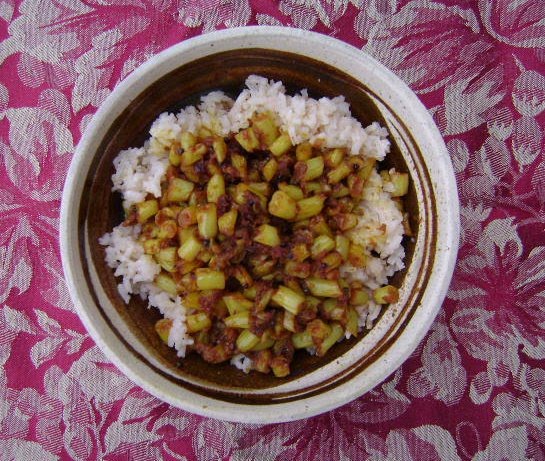
I found the perfect recipe to make: Green Beans with Onion Paste, which really deserves a much more glamorous name as it is redolent of so many spices. The beans are infused with so many levels of flavor as they slow cook in their tomato and onion gravy and it makes a hearty vegetarian meal over rice. Try it over basmati rice for extra fabulousness.


I have made the recipe twice now to rave reviews from my family. It is a slow food dish, requiring a good bit of time in the slicing of the beans, the sauteeing of the onion paste and spices, and then a bit of simmering, but the result is exquisite. You'll also creating a bit of work for the dishwasher, but they will lulled into submission when you make them this dish. Make a double quantity if you have a ton of beans, as I did and you'll have lots of great leftovers to savor.


Back to Jaffrey's memoir. At Cook the Books, participants read a book and then blog up a review and cook a dish inspired by their reading. I've already sung my praises of Jaffrey's great bean recipe, so now here are my thoughts about "Climbing the Mango Trees". Jaffrey provides another great introduction to Indian culture for Western readers with this autobiography. I learned so much about the complexity of modern Indian history from reading about her interesting family.


The Jaffrey clan lived as an extended family of up to 40 people, ruled by Babaji, the grandfather, in a sprawling orchard estate outside of Delhi in northern India. The Jaffreys were Hindus in this part of British India that was ruled by Moghul leaders that were Muslim, so the combination of cultures and religions during the 1930s-50s is interesting to read about. The family was well-off, so that servants cooked the meals. While little Madhur grew up to become a well-known food writer (and actress), she never spent much time in the family kitchen, though her childhood food memories are vivid indeed.

I was particularly enchanted by her description of a wintertime confection that an elderly lady dressed all in white used to bring by for a breakfast treat. Daula Ki Chaat was made by taking rich milk and mixing it with dried seafoam. The Lady in White would then ascend to her roof top and leave little terra cotta cups of this mixture to chill in the night air. In the morning, if the collected dew was in just the right amount, she would froth it up, adding a little sugar, dried sheets of milk and shavings of pistachio nuts. How's that for magical food?

Another evocative passage was about summer mango parties, which her mother called "sweetenings of the mouth", that were held to celebrate successful school exams. Madhur's mother would invite the family to sup on ice cream, rasgulla (cheese balls in syrup) and juicy mangoes and the image of them all whiling away a hot afternoon with jasmine in their hair, trying to avoid drips on their immaculate white saris and kurtas, has stayed with me.

Ms. Jaffrey provides plenty of other wonderful food-infused memories throughout her memoir, which ends when she leaves India by ship to attend the Royal Academy of Dramatic Arts in faraway London. That is where she began to pine for a taste of home, and where her adventures in cooking them up from her mother's handwritten recipes would begin. I look forward to reading what I hope will be another installment of this interesting and extraordinary life.

You can join me in reading, cooking and blogging about this wonderful book by the Cook the Books deadline of Friday, September 24, 2010. My CTB cofounder, Deb, of Kahakai Kitchen, is hosting this round and you can find out the details about how to participate on the Cook the Books website. Perhaps you will be inspired by the collection of treasured family recipes provided at the end of the book to join us at our Cook the Books roundup.

Thursday, July 29, 2010

Cook the Books Club: The School of Essential Ingredients

Imagine a serene restaurant somewhere in the Pacific Northwest where the gentle instructor guides a small group of food lovers in the art of cooking and not so incidentally in understanding how to solve their own problems in life. Students learn not only to overcome their fears in whacking live crabs for the pot and tackling new recipes with confidence, but come to understand themselves better through their work in the kitchen.

Such a place exists in the great novel written by Erica Bauermeister, "The School of Essential Ingredients", which is the current selection of The Cook the Books club, an online foodie book club. Though each reader will no doubt have different interpretations about what the Essential Ingredients might be in cooking and in life, I came away with the idea that love, acceptance, time and self-contemplation should be part of the mix in cooking for one's loved ones.

Our heroine is restaurateur Lillian, whose own story is about an unsettled childhood in which her mother has retreated into years of obsessive book reading after a bruising divorce. The back stories of the other characters at the School of Essential Ingredients are doled out slowly throughout the novel and it is an interesting cast of people with different backgrounds and problems that unfold as the cooking lessons progress.


Bauermeister writes lyrically and there is much to savor in her sensual writing. I found that I wanted and needed to read the book a second time to fully experience the nuances in her prose and I have to say that I enjoyed the rereading even more. There's poetry in there, and philosophy, and delicious bits of foodie prose too, so it was a thoroughly satisfying read that I would recommend highly.

Cook the Books participants read our selected book every other month and then blog up their thoughts along with a culinary dish (and sometimes a whole feast!) inspired by their reading. I had originally planned a CTB post featuring a special dessert that was slow food indeed, highlighting my special appreciation for TIME as one of Essential Ingredients, but then obstacles to my blogging life started to accrue.

After suffering a spate of technical difficulties this steamy summer with the various mechanical devices in my life (fried hard drive on my beloved ten year old computer, car problems, clothes dryer (air drying hasn't been terribly effective this hazy, humid summer), garden hose nozzle, food processor, digital camera, stove burners) I was beginning to wonder if I would be able to get my blog post up for this round of Cook the Books. I am the host this round, so there has been extra pressure to get cracking, but my primary blogging tools have been altered indeed.

I actually had most of a nice, informative post on making a simple syrup of anise hyssop, which I stewed some stone fruit in for a cool, perfumed dessert one of these hot nights, but my photos and musings were zapped inside my old computer. Fortuitously, I was able to figure out how to use my daughter's camera to take some shots of a new dish inspired by our CTB book and after figuring out how to drive on my new computer and its operating system, my blogging is back in business. I think Lillian would be nodding her head at me in approval right now.

What I present to you all then, as my Cook the Books dish, is a cool eggplant salad, featuring the Essential Ingredient of Love. I made this dish for my husband to consume upon his return from a terrifically sweaty and dusty weekend away with my youngest daughter at a softball tournament. Though we packed Dan up a cooler of gluten-free delights to nosh on during the weekend, he was down to snacking on corn chip dust and water by the end of his travels (concession stands at hometown sporting events are notoriously gluten-packed) and when he returned from his exhausting odyssey I was there to comfort him with sweaty kisses, clammy hugs and a bowl of this cooling salad, made with garlic, shallots and basil from our garden.


This dish is adapted from a much-loved and dog-eared staple in my personal cookbook library, Bert Greene's "Greene on Greens".

Fried Eggplant Salad with Shallots, Lemon and Basil


1 large eggplant
Salt
Olive oil
2 shallots, peeled and sliced thinly
2 cloves garlic, peeled and finely chopped
Juice of two lemons
Salt and pepper to taste
1/2 cup basil, thinly sliced

Trim ends off eggplant, and then slice in half lengthwise. Slice each section into 1/4 inch thick half moons. Place eggplant slices in a colander in the sink and sprinkle them liberally throughout their layers with about 2 tsp. salt. Let stand 30 minutes.

Using paper towels, brush as much salt off the eggplant slices as you can and give them a squeeze to drain off excess liquid.

Heat 2 Tbsp. olive oil in a large frying pan. Place eggplant slices to cover bottom of pan. Drizzle with a little more olive oil and then fry until lightly browned, about 2-3 minutes per side. Remove eggplant to dish lined with paper towels. Add another bit of olive oil to the pan to coat the bottom, heat and then continue frying up all the eggplant.

When all the eggplant is cooked, pour another 2 Tbsp. olive oil into the pan and heat it up. Add shallots and garlic and saute, stirring occasionally, until they are soft and golden brown, about 7 minutes.

Find a beautiful serving dish and layer the bottom with a layer of fried eggplant and then some of the fried shallots and garlic. Sprinkle with some of the lemon juice and sliced basil. Sprinkle with a dusting of salt and pepper. Repeat layers twice.

Serves 6. This seemed tastiest served at room temperature, but we also enjoyed it cold straight out of the refrigerator.

I will be posting a roundup of all the savory and exciting blog posts about "The School of Essential Ingredients" after our deadline, which is tomorrow, July 30, 2010. The author herself, Erica Bauermeister, will be serving as the guest judge for our posts, so tune in to Cook the Books over the course of the next week to see what we all thought about the novel.

For our next book selection, we will be reading Madhur Jaffrey's "Climbing the Mango Trees: A Memoir of a Childhood in India". Anyone can join in the fun at Cook the Books; all you need to do is read the book, blog about your thoughts and cook up a dish inspired by your reading. Please join us!

Wednesday, May 19, 2010

I Eat for England with a Gluten-Free Ploughman's Lunch Picnic

Americans and Brits seem to speak the same language, but really we don't. American soldiers wear camouflage and ride around in tanks; English soldiers get dipped in runny egg yolk. American seaside rock pokes your feet when you are wading into the surf, but Brits pop their sugary version into their mouths to suck on. The British eat rocket; Americans launch same. And I used to have to babysit a bunch of jammy dodgers, but in England they are considered a biscuit. By which they mean a cookie.


And that is the chief delight of reading Eating for England: The Delights and Eccentricities of the British at Table by Nigel Slater (London: Fourth Estate, 2007). This whimsical collection of mini food essays is the current book pick for Cook the Books, the bimonthly online foodie book club that I co-host with two food blogger buddies, Deb of Kahakai Kitchen and Jo of Food Junkie, Not Junk Food. As a devoted Anglophile and logophile I loved learning about all the Britishy foods that I've read about in novels through the years and figuring out that a dog's dinner is not a bowl of kibble, but a real mess of things.

All the better to savor the short takes on British foods, traditional and modern, that author Nigel Slater slings about with great humor and elucidation for this American reader. Many of these foods beloved by Britons have such wonderfully distinctive names: Junket, Pontefract Cakes, Faggots and Gravy, Gooseberry Fool, Jam Roly Poly, Chudleighs and Old English Spangle and it is delightful to read about their history and what they are exactly.

I loved his writings about brussels sprouts, the fond descriptions of his childhood sweets, and was particularly taken by one paragraph about British cakes that "have a certain wobbly charm to them, and what might be missing in terms of finesse is there in lick-your-fingers stickiness". They are "not delicacies you eat politely with a cake fork, they are something you tuck into with the enthusiasm of a labrador at a water bowl" (p. 13)

Slater is also devastatingly funny when he sums up the various species of cooks: the pedant who never deviates from a recipe, the pre- and post-Jamie Oliver Man (the former cooks up "The Great Dish" and must not be criticized, even though there are mounds of dishes in the aftermath, and the latter thinks nothing of purchasing a champagne-priced bottle of vinegar). I must confess I think Nigel may have described me a bit too closely for comfort in his passage on "The Grow-Your-Own Cook": George Bush face planted on the garden scarecrow (great idea!); sunflowers left over in the garden to feed the winter birds (check!); committed recycler, compost-maker and seed-sower (triple check!); kitchen pots are old and mismatched (home run!); knives and forks were their grandmothers (whoa!); every ingredient is organic or free-range or made by a tousle-haired artisan (slow down, Nigel, I am also a cheapskate, so I do hie off to the supermarket for quite a lot of kitchen shopping).

I thought about what to make from this terrifically entertaining book for quite a time. All those British sweets seemed so tempting, but eventually I decided to try my hand at a Ploughman's Lunch since the Spring weather has turned so mild of late and we are enjoying picnicking out of doors again.

The Ploughman's Lunch is a modern British pub staple, consisting of bread, cheese, chutney or pickle and a nice pint of ale. It is supposed to conjure up a rustic lunch such as an English farmer might have enjoyed after a hard morning in the fields, though there is some evidence that this may all be an advertising ruse cooked up by the British Milk Marketing Board in the 1960s to sell more cheese. Perhaps dreamed up by this fab cat with the monocle. The Mr. Peanut of Cheese.


Ruse it may be to suggest that this modern pub fare is a British working man's lunch from time immemorial, I thought it sounded rather tasty and decided to pack up a robust ploughman's picnic for my sweetie and I to enjoy after a rugged morning of edging the garden and turning that overwintered compost pile, Good Grow-Your-Own Cooks that we both are.

Here's what we ate:


I made up a batch of Sesame-Rosemary Crackers, a cream cheese and chutney ball rolled in some garden parsley and chives, cucumbers, apples, a couple of bottles of naturally gluten-free hard cider, a jar of pickled onions, and a selection of English cheeses: a Cheddar, a sliver of White Stilton with Lemon Zest and a Double Gloucestershire.

Cheddar needs no description, so I will proceed to give you a virtual taste of Double Gloucestershire, a hard cheese, rather like a mild Cheddar or Colby, but a bit creamier on the tongue. It is perhaps most distinctively known as being the cheese of choice in Cheese Rolling, an extreme English sport involving a hurtling run after the coveted cheese wheel down a steep hill, with both participants and spectators in danger of injury from the speeding cheese and out-of-control Cheese Roller athletes. You can read more about Cheese Rolling in True Brits, by J.R. Daeschner, a book I reviewed a couple of years ago here.

And now, back to the cheese. Lemon Stilton was a lovely choice. There are two kinds of Stilton, a blue cheese with deliciously moldy veins running throughout and a milder version which is studded with dried fruits, ginger and in my case, bits of lemon zest. This was subtly sweet, crumbly, and full of lemon perfume. A bit messy, but tasty enough to overlook that.

For a wonderful take on the Ploughman's Lunch, I refer you to Foodycat's excellent post this past January, in which she put together a sumptuous repast of Beer Damper, homemade pickled onions and two kinds of wonderfully-named English cheeses, Hereford Hop and Dambuster.

Foodycat will be the judge of all the blog entries we receive this time round for Cook the Books and will no doubt bring her wit and kitchen erudition to this task. I credit her with inspiring me to try my hand at pickling a jar of onions, a slow food task indeed, as it requires a bit of salting, brining and waiting to make a proper batch. I turned to this recipe for English Pub Style Pickled Onions, and fiddled with the ingredients and seasonings to make it gluten-free (traditional malt vinegar is not gluten-free).


Here's what I did:

Britishy Pickled Onions

1/2 cup pickling salt (do not substitute regular table salt)
2 quarts water

1 1/2 lbs. boiling onions (also known as pearl onions, the ones you make traditional creamed onions with at Thanksgiving)

2 Tbsp. brown sugar
2 c. cider vinegar
1 teaspoon black peppercorns, crushed roughly in a mortar and pestle
1/4 tsp. ground allspice
1/4 tsp. hot pepper flakes
1 bay leaf, crumbled
2 Tbsp. snipped fresh chives


Dissolve 1/4 cup salt in 1 quart water in glass bowl. Add the
onions. Weight them gently with a plate that fits inside the bowl (I used a can of 14 oz. can of pineapple on a saucer). Let them stand overnight.

Drain the onions, and peel them. Remove tips of onions with a sharp knife. Return them to the bowl. Make another brine with the remaining 1/4 cup pickling salt and water, pour it over the onions,and weight them gently again. Let them stand 2 days. This will soften them, but they will still have a bit of a crunch at the end.

In a nonreactive saucepan, bring the sugar and vinegar to a boil. Stir to dissolve. Let the liquid cool.

Drain and rinse the onions, and drain them well again. In a 1-
quart jar, layer the onions, peppercorns, allspice, pepper flakes,
bay leaf and chives. Cover them with the cooled, sweetened vinegar. Cover
the jar with a nonreactive cap, preferably all plastic.

Refrigerate the jar for at least 1 month before eating the
onions. They will keep for at least 6 months.

Well, I was on a Cook the Books deadline here, so I only waited two weeks before snacking on them and it was really quite tasty. The onions have a nice vinegary snap and are right in between being crunchy and soft.

The original recipe indicated that one could process these pickled onions in a water bath, in which case you would sterilize 2 pint jars, bring the vinegar mixture and onions to a boil and then seal and process 10 minutes in a hot water bath.

Makes 1 quart or 2 pints pickled onions.


You can see the full range of book reviews and blog posts for all the Cook the Books participants who read "Eating for England" after our May 21st deadline. Come see what we all cooked up!

Thursday, March 18, 2010

Like Water For Hot Chocolate: Time to Cook the Books!

Way back in the 80's, author Laura Esquivel published her glorious novel, "Like Water for Chocolate", which became a bestseller in Mexico, the U.S., and many other countries. The success of this novel, where food has magical, life-altering properties, has inspired many other authors to give chefs, food and recipes center billing in many other novels and even spawned a new subgenre of literature, the "foodie novel".

Deb of Kahakai Kitchen, my wondrous co-hostess at Cook the Books, the online foodie book club, selected this great book for our February/March round and I was delighted to transport myself back to the early 20th century Mexican ranch belonging to the de la Garza family. Mama Elena is the iron-fisted ruler over her three daughters, and decrees early in the book that youngest daughter, Tita, must never marry until after she dies.

This breaks Tita's heart, for she loves Pedro (I never did figure out why, as he just seems like a lunkhead to me), and her emotions throughout the book flow into her cooking and cause strange things to happen. Esquivel's book was the first that I know of that sprinkled recipes throughout the text, much as other novels have traditionally headed chapters with quotes from poems or other literary sources.

There were many cool recipes for dishes and home remedies in the book that could have inspired me to cook and blog them up. I considered the sensuality of Quail in Rose Petal Sauce and the Mexican holiday classic of Three King's Bread. The thought of making my own matches, however, seemed unwise (and where does one purchase minium and powdered potassium nitrate, anyway?) I found a blogging duo who actually cooked up a whole feast from the book (actually the movie version of Esquivel's book) and that seemed pretty intriguing, but ultimately I settled on making a treat of cookies and hot chocolate for my family on a blustery weekend afternoon.


I followed my usual scratch recipe for hot chocolate from the back of the cocoa powder container (cocoa, dash of salt, warm milk and a bit of vanilla), spiced up with a hint of cinnamon. For accompaniment, I hit a bunch of cookbooks for Mexican baking recipes and chose to make a gluten-free version of Polvorones de Canela (Cinnamon Cookies) from The Moosewood Collective's cookbook "Sundays at the Moosewood Restaurant".

I 've seen recipes for similar butter cookies rolled in powdered sugar called Mexican Wedding Cookies or Mexican Shortbread (add nuts). Other cooks from other countries also make cookie cousins to these little gems: Russia has her Tea Cakes (add nuts again) , Southern American cooks make Butterballs or Snowballs, and the Germans and the Dutch make Pfeffernusse (add black pepper and/or cloves). Obviously this many wonderful cooks from around the world must be onto something.

Adaptation of recipe for Polvorones de Canela from "Sundays at the Moosewood Restaurant" by the Moosewood Collective (NY: Simon and Schuster, 1990).

Polvorones de Canela (made gluten-free)

1 cup butter, softened
1/2 cup confectioner's sugar (also known as powdered sugar or 10X sugar)

1/2 tsp. cinnamon
1/4 tsp. salt
1 tsp. vanilla

1/2 cup sorghum flour
1/2 cup brown rice flour
1 tsp. xanthan gum

1 cup confectioner's sugar
1 tsp. cinnamon

Cream together butter and 1/2 cup confectioner's sugar. Add in 1/2 tsp. cinnamon, salt and vanilla.

Mix together sorghum flour, brown rice flour and xanthan gum. Fold into creamed mixture and mix well. Wrap in plastic wrap and chill in refrigerator for at least one hour.

Preheat oven to 350 degrees F.

Roll dough into one inch balls. Bake on greased baking sheet (I used parchment paper to line my cookie sheets since GF cookies tend to stick more easily.

Mix together 1 cup confectioner's sugar with 1 tsp. cinnamon.

Bake cookies 15-20 minutes or until lightly browned. Don't overbake as this will make them desert dry (one batch escaped my baking attentions and was terribly dry). Let cool for a few minutes and then roll cookies in cinnamon-sugar mixture while still warm. Let cool.

These are terrific served warm with hot chocolate to dunk them in. They also pair well with coffee.

Makes 30 cookies. Store in airtight containers.

If you haven't read "Like Water for Chocolate" you are in for some great entertainment. There is still time to join our online book club (the deadline is March 26 to read the book, cook something up and blog about it) at Cook the Books, where our guest judge this month is Ben of the awesome food blog What's Cooking? Ben certainly knows his way around Mexican cooking, having grown up with restaurateur parents, and he also is a fan of Esquivel's book, as noted in his review on his blog. Deb will be organizing a roundup of all the participants' posts about the book and their inspirational dishes, and then Ben will give us his thoughts. Do drop by and check it out!