Showing posts with label Indian Food. Show all posts

Monday, November 29, 2010

WHB Hosting and the Gluten Free Food Find of the Week: Poha

When groceries are so inexpensive at the Asian markets in Albany, I feel free to grab packets and bottles and cans of interesting-looking new edibles and fling them in my cart without remorse. We've discovered so many great naturally gluten-free new foods (one must still read labels diligently though) including new varieties of rice, a world of gluten-free noodles from all kinds of culinary traditions, and wildly exotic spices and sauces.

One of my new favorite discoveries is poha (also spelled pohe), a Western Indian comfort food. Poha is a quick cooking product made of pounded or flattened rice that is available in either thick or thin varieties. I bought a package of thick poha for $1.89 at the Indian Bazaar on Central Avenue in Albany that contained 4 cups of poha, enough for two separate dinners for our family of four.

According to my blogger colleague TongueTicklers, poha is one of the first solid foods that children smack their gums upon. She also notes that a dish of poha is a favorite breakfast or snack food and gets packed in many a lunchtime tiffin, whether it is cooked up savory or sweet. Since I have more of a salt tooth, I went savory for my poha test drives.


First I cooked up TongueTicklers' recipe for Kaanda Pohe, which pairs poha with sliced potatoes, which sounds like altogether too much starch, but which blends together beautifully. I added some (well, a lot) curry leaves that I sauteed with the spices and this was an aromatic and belly-filling dinner indeed. You soak your poha in water for a short while and then drain it in a colander. It absorbs the liquid and becomes sort of spongy, rather like a rolled oat, with a delightfully chewy texture.

I also tried poha again a week later without the peanuts, topped with the chopped up last blast of cilantro from the garden. Another winner.


Scheduled next on the Crispy Cook poha experiment trials will be this recipe for Mane Adige's recipe for Gojjavalakki, in which you whir your poha around in the blender or food processor and cook it up with tamarind, rasam powder and other spices. Sounds divine. But gotta trek back down to the Big City to buy more poha!

I am going to include this poha post in this week's edition of Weekend Herb Blogging, which is now in its fifth year, making it one of the Grand Old Dames of food blogging events. Weekend Herb Blogging started over at Kalyn's Kitchen and is now run by Haalo of Cook Almost Anything. The weekly event includes posts about edible plant ingredients, whether they be fruits, vegetables, seeds, grains, legumes, herbs, or flowers. I always find out about new ingredients and new ways to prepare old favorites with this event.


As the guest host of Weekend Herb Blogging #262, I would love to showcase your blog post, which may contain a recipe or information about growing or using a plant ingredient, to include in my recap after this week's deadline of Sunday, December 5, midnight Eastern Standard Time. WHB submissions must include a link back to The Crispy Cook and to Haalo's WHB rules link. WHB submissions must also be specifically written for this blog event and not cross-posted to other blog events.

In your email submission (to oldsaratogabooks AT gmaildot coM) please include the following information:

* Your Name
* Your Blog Name/URL
* Your Post URL
* Your Location
* Attach a photo (please check the details below for specific photo requirements)

Looking forward to seeing what you and other great cooks from around the world will be submitting!

Friday, August 20, 2010

Cook the Books Club: Climbing the Mango Trees and Picking the Beans with Madhur Jaffrey

The combo of daily sunshine, just enough rain and warm nights has produced a vegetable explosion in our home gardens this season, and the Crispy Cook has been pretty good at keeping up with the harvest by canning and freezing and cooking up armloads of tomatoes, basil, broccoli, cabbage, zucchini and peppers. I cut back on the number of plants (especially those super-fertile summer squashes) and the variety of veggies we usually grow, devoting about half of our garden space to garlic after seeing how successful that went with last year's first garlic harvest.

But I forgot about how prolific bean plants can be.

I usually grow one or two kinds of string beans each year and this year it was just half a seed pack of wax beans (those yellow string beans that are easier to spy on the green bean plants, I grew the Carson variety) that went into the ground in early summer. The bean plants just went wild this summer and it seemed like no sooner had I picked a colander full of crisp yellow beans, then there was another cluster hanging from the plants. My favorite way to enjoy wax beans is in a salad with tomatoes but after making this excellent dish several times, I turned to my cookbook shelf for more beany inspiration.


Since our foodie book club, Cook the Books, is currently reading Madhur Jaffrey's book "Climbing the Mango Trees: A Memoir of a Childhood in India" (NY: Alfred A. Knopf, 2006), I turned to her wonderful "An Invitation to Indian Cooking" (NY: Alfred A. Knopf, 1973). This is one of my most well-loved cookbooks since purchasing a paperback copy in a used bookstore many moons ago when I was first living and cooking on my own. I have since upgraded to a nice hardcover edition since my bespatterings and cracking of the spine beat up my original copy. I can recommend it wholeheartedly as a great introduction to the cuisine of Jaffrey's Delhi hometown, especially for American cooks who want to familiarize themselves with Indian ingredients and cooking techniques.

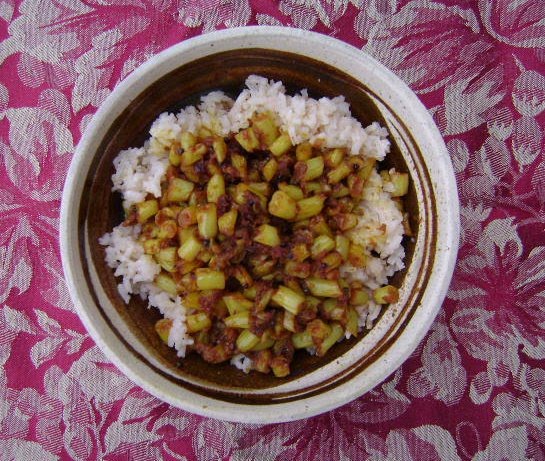
I found the perfect recipe to make: Green Beans with Onion Paste, which really deserves a much more glamorous name as it is redolent of so many spices. The beans are infused with so many levels of flavor as they slow cook in their tomato and onion gravy and it makes a hearty vegetarian meal over rice. Try it over basmati rice for extra fabulousness.


I have made the recipe twice now to rave reviews from my family. It is a slow food dish, requiring a good bit of time in the slicing of the beans, the sauteeing of the onion paste and spices, and then a bit of simmering, but the result is exquisite. You'll also creating a bit of work for the dishwasher, but they will lulled into submission when you make them this dish. Make a double quantity if you have a ton of beans, as I did and you'll have lots of great leftovers to savor.


Back to Jaffrey's memoir. At Cook the Books, participants read a book and then blog up a review and cook a dish inspired by their reading. I've already sung my praises of Jaffrey's great bean recipe, so now here are my thoughts about "Climbing the Mango Trees". Jaffrey provides another great introduction to Indian culture for Western readers with this autobiography. I learned so much about the complexity of modern Indian history from reading about her interesting family.


The Jaffrey clan lived as an extended family of up to 40 people, ruled by Babaji, the grandfather, in a sprawling orchard estate outside of Delhi in northern India. The Jaffreys were Hindus in this part of British India that was ruled by Moghul leaders that were Muslim, so the combination of cultures and religions during the 1930s-50s is interesting to read about. The family was well-off, so that servants cooked the meals. While little Madhur grew up to become a well-known food writer (and actress), she never spent much time in the family kitchen, though her childhood food memories are vivid indeed.

I was particularly enchanted by her description of a wintertime confection that an elderly lady dressed all in white used to bring by for a breakfast treat. Daula Ki Chaat was made by taking rich milk and mixing it with dried seafoam. The Lady in White would then ascend to her roof top and leave little terra cotta cups of this mixture to chill in the night air. In the morning, if the collected dew was in just the right amount, she would froth it up, adding a little sugar, dried sheets of milk and shavings of pistachio nuts. How's that for magical food?

Another evocative passage was about summer mango parties, which her mother called "sweetenings of the mouth", that were held to celebrate successful school exams. Madhur's mother would invite the family to sup on ice cream, rasgulla (cheese balls in syrup) and juicy mangoes and the image of them all whiling away a hot afternoon with jasmine in their hair, trying to avoid drips on their immaculate white saris and kurtas, has stayed with me.

Ms. Jaffrey provides plenty of other wonderful food-infused memories throughout her memoir, which ends when she leaves India by ship to attend the Royal Academy of Dramatic Arts in faraway London. That is where she began to pine for a taste of home, and where her adventures in cooking them up from her mother's handwritten recipes would begin. I look forward to reading what I hope will be another installment of this interesting and extraordinary life.

You can join me in reading, cooking and blogging about this wonderful book by the Cook the Books deadline of Friday, September 24, 2010. My CTB cofounder, Deb, of Kahakai Kitchen, is hosting this round and you can find out the details about how to participate on the Cook the Books website. Perhaps you will be inspired by the collection of treasured family recipes provided at the end of the book to join us at our Cook the Books roundup.

Saturday, November 29, 2008

Bhajis Enable My Legume Love Affair

Some time ago I discovered Jeena's Kitchen's fabulous Onion Bhaji recipe. It was an instant hit with my family and has become one of our quick and easy recipes for weekday nights. I have made these Indian oven-baked delights with various kinds of vegetables, including thawed (and squeezed out) packages of our garden string beans, diced par-boiled potatoes, blanched cauliflower and even blanched Brussels Sprout halves, and they are always winners. The vegetables get delightfully CRISPY and we make bhajis at least a couple of times a month.

Dan even made bhajis one night for supper using a jar of my pickled dilly beans thinking somehow that they were just like our frozen green beans, and while they were not great, they were edible. Their taste was how I imagine a deep-fried pickle is.

Jeena's Onion Bhaji recipe is fantastic and uses buckwheat flour and a great mix of spices. Her recipe blog, which features many other gluten-free recipes, is a great resource and has many detailed instructions and photographs to guide you along on your first go at these delicious little fritters. She has also recently added a video of this marvelous recipe so you may want to view this step-by-step instruction before you whip up your dinner.


We make our bhajis and like to accompany them with some rice, a dab of Cucumber Raita and some Apple Chutney. One batch of bhajis with these condiments makes a hearty dinner for four, but they can also be served as an appetizer or first course for more hungry mouths.

I like to make Jeena's recipe with chickpea flour, or besan, which I find at my health food store. Larger urban area grocery stores may carry this in the natural foods or Indian foods section. The buckwheat flour version is fluffier, but the chickpea flavor seems to be our favorite. We also add in chopped pickled ginger, snipped fresh cilantro or chives from the garden and substitute cumin seeds for ground cumin for a little variety.

Here's my tweaked-up version of the Jeena's Kitchen recipe using green beans and our customized seasonings. No doubt we will keep playing around with this versatile recipe. I plan to try it with shredded zucchini and summer squash and perhaps chunks of sweet potatoes. Hopefully you will love this recipe too and come up with your own special version.

Green Bean Bhajis

1 medium onion, peeled and sliced thin
2 cups blanched green beans (I use frozen green beans) squeezed dry
Olive oil

First Seasoning Mixture:

1/2 tsp. chili powder
1/2 tsp. turmeric
1/2 tsp. cumin seeds

Second Seasoning Mixture:

2 Tbsp. pickled ginger, finely chopped
3 Tbsp. fresh cilantro, finely chopped
1/2 tsp. ground cumin
1/2 tsp. salt

5 Tbsp. chickpea flour
1 tsp. tomato puree or sauce
Several Tbsp. water

Preheat oven to 350 degrees F.

Heat 2 Tbsp. olive oil in frying pan. Add onions and saute until softened, about 4-5 minutes. Add beans and heat through, another 2-3 minutes. Add first seasoning mixture and continue to cook, stirring, another 2-3 minutes, or until spices are fragrant.

Take off stove and pour into medium-sized mixing bowl. Add chickpea flour and second seasoning mixture. Stir to coat beans and onions well. Add tomato puree and a tablespoon of water to make into a batter consistency. Add more water, a tablespoon at a time, if needed for right consistency. You don't want the bhajis to be runny, just moistened. If you think your bhaji batter is too wet, add another tablespoon of chickpea flour.

Drizzle olive oil to coat two cookie sheets. Drop about 2 Tbsp. bhaji batter onto your sheets for each bhaji. Flatten a little with spoon.

Bake 10 minutes. Remove trays, flip your bhajis so they brown evenly and return to oven for another 5-10 minutes.

Bhajis are best served right away, but for the rare occasions when we have a few leftovers, they are also good reheated in the microwave over some more rice.

Serves 4 as dinner, or more for appetizers.

This is so delicious, you will have to try it. Make sure to try Jeena's original Onion Bhaji recipe too with the buckwheat flour and her delicious spice combinations to see which you enjoy best. I know my husband pouts when I promise him a bhaji dinner and then make something else, so you know this is good!

Simona at Briciole, a wonderful food blog that offers definitions (and audio file pronunciation) of Italian culinary terms AND mouthwatering recipes, is the current host of My Legume Love Affair, which celebrates the awesomeness of the legume and is the baby of Susan over at The Well-Seasoned Cook. This Green Bean Bhaji recipe is my contribution to MLLA, which runs until tomorrow. Be sure to check back with Briciole to see a noteworthy roundup of beany recipes.

Simona is also the co-host of another event, Novel Food, which invites readers to select a novel, short story or other literary work and cook up an inspirational recipe. I have something in mind for this fun event, which runs until December 20, 2008. If you would like some more Foodie Fiction fun, be sure to check out Cook the Books, a new book club started by yours truly and two other blogger buddies, Food Junkie and Kahakai Kitchen. We are reading "La Cucina" by Lily Prior and cooking and blogging about Sicilian foods inspired by this lush and lusty novel by the December 15 deadline. Come joins us!

Saturday, July 5, 2008

Putting Up the Cilantro Harvest with the Book of Yum


Sea over at the Book of Yum is my kindred gluten-free cooking spirit. While she may be an urban dweller on the West Coast, and I'm a rural devotee on the East Coast, she and I share a love for vegetables, herbs and adventurous cooking. She's the first foodie blog I check every day and I'm always delighted by the fresh take on a recipe, her good natured and detailed commentary about her kitchen experiments and her interest in Asian, Indian and other international flavors.

Our family has enjoyed her Southern Fried Tofu recipe quite a lot and I was delighted when she started the Adopt a Gluten Free Blogger Event this past winter so that I could have an excuse to try out some of the many bookmarked recipes in my pile.

I have enjoyed adopting Jeena's Kitchen (Onion Bhajis), The GFCF Experience (Brownie Tart), Fresh Ginger (Lard Nah) and Gluten A Go Go (Coca-Cola Cake) in the past rounds of this event, and now I am pleased to adopt our Founder, Sea. from the Book of Yum, in this fifth round. I have a ton of cilantro coming up in my garden and before it bolts overnight, I harvested two huge bunches to make Sea's recently posted Cilantro Chutney recipe.

I had all the ingredients in my pantry and garden except for the asafoetida/hing, which a quick trip to Wikipedia informed me was a plant seasoning also known as Devil's Dung (?!?) which lends a leek-like flavor to dishes when cooked. I opted to substitute in 2 cloves of finely minced garlic instead of this quaintly-named delight and things seemed to be tasty enough. Whirling around this chutney in my food processor produced just enough chutney to fill twelve spots in my ice cube tray. I froze this overnight and then popped out the cubes into a freezer baggie to be pulled out well after cilantro season for spicing up raitas, yogurt dips, and zipping up my canned salsa. Thanks Sea, for helping me with my summer garden harvest and for starting this fun foodie event!

Sunday, April 20, 2008

Mango & Red Pepper Chutney

I recently joined the Foodie Blog Roll (see sidebar) hosted by the Leftover Queen and there is a monthly Food Joust in the Queen's honor. This cooking event challenges participants to develop a recipe using three ingredients put forth by the preceding winner. The May Joust trio includes mangoes, cardamom and brown sugar, which inspired me to make a mango chutney to go along with all the bhaji mania and Indian-influenced recipes my family loves.

Mangoes are a new fruit for me. I have bought many a jar of Major Grey's mango chutney, but I don't think I have ever enjoyed a fresh mango, much less cooked with one. I did a little research on various mango chutney recipes and none that I saw called for cardamom, but this spice has a nice ginger and lemon taste, so I thought it would work well in a chutney. The other chutneys I have made from apples and tomatoes have all turned a uniform molasses brown, so I thought a bit of red pepper would brighten up the color.

I was able to get three hard green mangoes at the supermarket and waited for them to brighten up and ripen, but it seems I got them in three different stages of development. After five days, one was half-red and going a bit soft, one was springy and only a little bit red and one remained green and hard. It was time to start experimenting....

My copy of Nuevo Cubano Cooking (by Sue Mullin, NY: Chartwell, 2003) advised wearing rubber gloves in case of skin allergy. A little more Internet research showed that mangoes are botanically related to my diabolical arch-enemy, poison ivy, which turns me into a puffball with slitted eyes, so I made sure to wear my dishwashing gloves when I chopped up these fruit. I did cut off a few yellow rubber fingertips as the mango flesh is slippery and has a maddening attraction to its huge, flat pit, but I didn't want to end up a scratchy, puffy mess, so I stuck with it.

The best way to cut a mango is to make longitudinal cuts along the crazy center pit, and this website has lots of good instructional photos, so I am glad to have found that thanks to another Foodie Jouster. Then you can score the fruit and scoop it away from the peel directly into a bowl from the two outside pieces. I kept my pieces on the large side since I figured they would cook down in the chutney, and this turned out to be the case. Ripe mango is quite tasty and I will have to get some for future fruit salads.

I have some experience canning, so I went ahead and processed my mango chutney in a boiling water bath, but since this only makes a small batch, 2 cups, you could also just refrigerate it. All the vinegar and spices should keep it for several months, if properly covered. If you do want to experiment with canning, it's really not as scary as it sounds at the outset. Do invest in a jar lifter, proper jars and lids and a wide-mouth funnel and make sure you have a good recipe to follow. You need a strong back and hands to lift the heavy canning pot full of water and jars and you want to be extra-cautious when handling boiling-hot jars, but there is nothing more satisfying than hearing those lids seal ("POP!") when they cool and seeing your produce lined up on the pantry shelf. There are lots of great canning books and Internet resources to help you get started.

On to the jousting:

Mango and Red Pepper Chutney

1-1/2 cups brown sugar
3/4 cup cider vinegar

3 ripe mangoes (not over-ripe), peeled and cut into chunks
1 medium onion, peeled and roughly chopped
1 red pepper, cut into 2 inch strips
1/4 cup golden raisins
2 big slices of crystallized ginger, chopped (mine was rock-hard so I pulverized it with a mortar and pestle; you could also substitute 1 tsp. ground ginger)
3 cloves garlic, chopped
1 tsp. yellow mustard seeds
3 cardamom pods, seeded and pounded a bit in the mortar and pestle (discard the husk)
1/2 tsp. red pepper flakes
2 Tbsp. snipped chives (adds a bit of dark color)

In an enameled pot, mix sugar and vinegar. Heat to boiling, stirring occasionally to melt sugar.

Add remaining ingredients and bring to boil. Simmer, uncovered, until a liquid is syrupy, at least 45 minutes. Don't cook too long or the all components of the chutney will turn a uniform brown.

You can then cool and refrigerate your chutney or process it in a boiling water bath for 15 minutes.

Makes 4 half-pint jars (two cups). This chutney is medium-spicy. If you want to kick up the heat you could add fresh chiles or cracked black pepper.

Mango chutney is a divine accompaniment to any curry or spicy food, great slathered on a cracker with cream cheese or try a peanut butter and chutney sandwich (PBC).

***There is still time to join me in this month's joust. Participants must blog and enter their entry in the Foodie Joust by May 1st. See here for the Jousting rules.

Monday, April 14, 2008

Cucumber Raita

Bhajimania continues at our house. The onion bhajis are favorites with the kids, while Dan and I like the string bean bhajis, especially as they use up the many bags of frozen beans we have in the freezer from last year's garden bumper crop. The beans, if thawed and wrung out well, get really crispy in the bhaji batter.

We've been eating them with basmati rice and mango chutney on the side for a divine trio, but last time I whipped up a cucumber raita for a toothsome quartet and now this will become our bhaji standard. For inspiration, I turned to one of my favorite and reliable cookbooks, Madhur Jaffrey's "An Invitation to Indian Cooking". We also used leftover raita to make a creamy vinaigrette later in the week and then threw it on top of some lentil chili. It keeps well and is a nice condiment to have around.

Cucumber Raita

1 cucumber, peeled and grated (if cucumber is seedy, cut out middle pulp first)
1 pint plain yogurt
1 tsp. kosher salt
2 Tbsp. minced cilantro
2 Tbsp. snipped chives
1/4 tsp. cayenne pepper
1 tsp. cumin seeds (these are preferable to ground cumin in this recipe for the crunch factor)

Mix all ingredients together and refrigerate for a few hours before serving to let flavors mingle.


Cucumber Raita

Saturday, April 5, 2008

Bonkers for Bhajis


The Book of Yum is hosting an Adopt a Gluten-Free Blogger Event and I decided to adopt Jeena's Kitchen over in England. Jeena is a professional chef with a blog full of clear and detailed recipes for healthy cooking, many of which are also gluten-free, as noted in her index. She has lots of photographs to guide you through each step of a recipe, which is so helpful when you are first attempting a dish or cooking technique. Many of the recipes are vegetarian as well, and many are twists on traditional Indian recipes.

I had long bookmarked Jeena's recipe for Onion Bhajis (pronounced "bah-zhees"), which are a popular British-Indian starter in many restaurants and a close cousin of the pakora or pakoda. Typically they are deep-fried, but Jeena's recipe calls for baking. I made her recipe and everyone in the family really liked them. I have paired them with basmati rice for dinner twice now and that makes an easy meal for everyone in the family to enjoy, even my vegan teenager. Jeena's recipe directs you to drizzle oil on the bhajis midway through the cooking time, but I found that flipping them over instead worked well in my often balky oven.


After a little bit of bhaji research, I found that they are usually accompanied by a cucumber raita or a mango chutney, so I will be whipping up some condiments for upcoming bhajimania. You can also serve bhajis on a bed of shredded lettuce with a squeeze of lemon or lime juice.

I tried making bhajis a third time with chickpea flour instead of buckwheat flour and they were even more delicious. The beaniness of the chickpea flour, which I don't fancy in my sweet treats, is perfect in this savory recipe. We're going to keep experimenting, as other bhaji recipes I've seen utilize other vegetables, such as string beans, cauliflower, potatoes, carrots, sweet potatoes, peppers, spinach and even brussels sprouts. The versatility of this recipe is exciting for me, and I can't wait to try other add-ins, like snipped chives, cilantro, mint and peas. When the garden produce starts flying in July and August, I look forward to playing around with other bhaji delights.

Vive Le Bhaji! And thank you, Jeena, for turning me on to a new family favorite recipe!

Monday, December 10, 2007

Some Gluten-Free Tidbits


There are some assorted bits of news and interesting Internet posts I thought I would assemble for a gluten-free sampler:

1) The GourmetSleuth blog has a useful grams to ounces converter that is helpful when adapting a recipe from the metric system to the American system of cups, ounces and teaspoons. There are a lot of great recipes from around the world so this should help with adapting recipes for home use. I am going to be putting this as a link in the sidebar on the right side of this blog.

2) Sea over at the exceptional gluten-free blog Book of Yum has a wonderful recent post about gluten-free snack packing and preparing for a long trip AND exciting and detailed posts on Indian cuisine and what to look for on an Indian menu that is safe to eat. Fascinating and beautifully photographed as ever. A must read.

3) The Chez Pim site has organized Menu of Hope 4 to benefit the United Nations Feeding Program in Lesotho, Africa. This great event features numerous raffles for dreamy food prizes, from cookbooks and cooking lessons, to tours of famous restaurants and shopping trips with world renowned chefs. Check it out until December 21st.

4) In a similar vein, you can help the UN World Food Program by testing your vocabulary at the Free Rice site. Of course we all love gluten-free rice, and this time-wasting and addicting site promotes a great cause.

5) I ran across this article on celiac-friendly beer and wanted to share this with others. We have been very happy with Redbridge Beer available at our local supermarkets but it looks like there has been more of a growth in the gluten-free beer market over the last year, so it looks like a trip to our beverage distributor might be in order.

Wednesday, May 9, 2007

A Versatile Americanized Curry


Many years ago my friend Barb taught me to make vegetable curry. She was fearless in her studio kitchen, sauteeing spices and chopping whatever vegetables were on hand to produce fragrant and quick vegetarian meals. She had learned some curry tricks from her erstwhile boyfriend and long after his sorry carcass had exited the door she at least had some good culinary skills. I made this curry with vegetables on hand, but it is versatile enough to include frozen or fresh peas, red peppers, green beans, sweet potatoes, leftover rice, cauliflower and other vegetable oddments. My kids don't especially like it, but they will in time, I'm sure.

Vegetable Curry a la Barb

3-4 cloves garlic, finely chopped
1 1-inch piece fresh ginger, peeled and minced
1 large onion, peeled and finely chopped
2 Tbsp. safflower or corn oil
1 (14.5 oz.) can diced tomatoes
1 (15.5 oz.) can chick peas, drained
curry powder to taste (someday I will make my own the proper way, but for now...)
4-5 small red potatoes, quartered and parboiled (or 2 large potatoes)
1 cup water
Handful of raisins
Salt and pepper to taste

Heat oil in frying pan. Saute garlic 1-2 minutes. Add onions and ginger and cook until golden. Add curry powder and stir 1-2 minutes. Add tomatoes, chick peas, raisins, potatoes and water. Bring to boil and then lower heat and simmer, covered, 20-30 minutes, or until vegetables are soft.

Serves 4-6.

Serve over hot cooked rice with mango chutney and plain yogurt.